admin
admin 
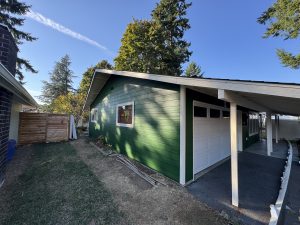
Picking an exterior color off a fan deck at the paint store is the easy part. Picking one that still looks right on your house next February, under a flat gray Bellevue sky, is the harder problem. Learning how to choose a paint color for a Pacific Northwest exterior means working backward from the things that don’t change: your roofline, your climate, and the wall of evergreens most Eastside homes sit in front of.
Start With What You Can’t Change
Before you open a single sample pot, look at your roof, any brick or stone on the foundation, and your driveway or walkway. These surfaces cost too much to replace just because a paint color clashes with them.
Pull your palette from the undertones already on the house. A roof with warm brown or bronze granules pairs poorly with a cool blue-gray body color; it works with warm grays, greens, and creams instead.
Don’t forget the smaller fixed elements either: gutters, downspouts, and window frames often stay the color they came in unless you’re replacing them. A new siding color that fights with an existing bronze gutter system will bother you every time you pull into the driveway.
Northwest Light Reads Color Differently Than a Store Swatch
Western Washington gets overcast, diffuse light for most of the year, and that flattens colors compared to how they look under the bright fluorescent lights at a paint counter. A green that looks vivid on a 2-inch chip can read muddy and gray on a whole house.
Buy actual sample pots and paint a two-foot square on at least two sides of the house, not just the side facing the street. Check it in the morning, at midday, and again on a rainy afternoon before you commit to five gallons.
Match the Palette to Your Home’s Style
Bellevue, Kirkland, and Bothell have a lot of Craftsman bungalows, and those homes generally hold up best in earthy body colors like moss green, warm taupe, or a soft brown, paired with cream or white trim.
Tudor-influenced homes on the Eastside tend to look sharper in a deep charcoal or forest body with white or cream accents around the timbering, rather than trying to match every wood tone.
Newer Northwest Contemporary builds carry black, charcoal, or deep navy siding well, especially against cedar accents, since the dark tone reads as intentional rather than heavy under our cloud cover.
Mid-century ranch homes around Redmond and Mercer Island usually look best in a warm gray or greige body with black or dark bronze window frames instead of stark white trim.
Plan Around Rain, Moss, and Shaded Siding
The damp climate here means north-facing walls and anything shaded by fir or cedar trees will collect moss and mildew faster than a wall in full sun. Darker greens and grays hide that staining longer between cleanings than pale colors do.
For the field color, a satin or low-sheen finish resists chalking and hides minor siding imperfections better than a flat finish does in our wet-dry cycle. Save semi-gloss for trim, doors, and shutters, where the contrast and durability matter more than hiding texture.
Proper prep matters as much as the color choice. A crew that scrapes, sands, and primes bare wood before the topcoat goes on is the reason a color still looks even two years later instead of blotchy after one wet winter. Peacock Painting backs its work with a 2-year guarantee on every exterior painting project, which is as much about the prep underneath as the color on top.
Build a Three-Color System
Most PNW exteriors work best with three colors: a field color for the siding, a trim color for window and door casings, and an accent color for the front door and shutters.
- Deep forest green body, white trim, black front door
- Warm gray body, white trim, forest green door
- Charcoal body, cedar-tone accents, brass or matte black hardware
Keep the accent color to the front door and maybe a shutter or two. Spreading a bold color across more than 10 percent of the exterior usually looks busy rather than intentional.
Check HOA and Neighborhood Rules Before You Buy Paint
Several Eastside communities, including parts of Bellevue, Clyde Hill, and Medina, have HOA-approved color ranges or historic guidelines that restrict how bright or saturated an exterior color can be. Read your CC&Rs or call your HOA before you buy five gallons of anything unusual.
If your neighborhood has no formal rules, it’s still worth a walk around the block. A color that looks great in isolation can feel out of place next to a row of similarly styled homes.
HOA approval also tends to take longer than homeowners expect, sometimes two to three weeks for a color submission to clear a review committee. Build that lead time into your project schedule if you’re planning to paint before a specific date, like a fall listing or a family gathering.
Carry the Decision Inside, Too
If you’re planning an exterior repaint alongside interior work, it’s worth choosing your trim and door colors with the entryway in mind. A black front door outside can carry through as a black stair rail or accent wall just inside the entry. Peacock Painting’s interior painting services can help you pick a trim white or accent tone that flows naturally from the porch into the front hall, instead of two unrelated color schemes meeting at the threshold.
Get a Second Opinion Before You Buy Five Gallons
A color that looks right on a sample board can still surprise you across an entire elevation. A short on-site walk-through with someone who paints Eastside homes for a living catches problems a swatch can’t: how the color reads against your specific roof, your trees, and your neighbors’ houses.
Peacock Painting offers free on-site color consultations as part of its residential painting services across the Eastside, and as Bellevue painting contractors who work block by block in these neighborhoods, the team can tell you which colors have held up well nearby and which ones fought the climate.
Frequently Asked Questions
How many colors should I use on a house exterior?
Three is the standard: one field color for the siding, one trim color, and one accent for the door and shutters. More than that usually looks scattered rather than deliberate.
What paint sheen holds up best on PNW exteriors?
Satin or low-sheen for the main body, since it resists chalking and hides minor surface texture through our wet-dry cycles. Semi-gloss on trim and doors gives contrast and wipes clean more easily.
Does exterior paint fade faster in the Pacific Northwest?
Direct UV fading is less of a problem here than in sunnier climates, but moisture, moss, and mildew cause more visible wear on shaded and north-facing walls. Color choice and prep both affect how long a finish stays even.
How long does an exterior paint job last in Western Washington?
A properly prepped and painted exterior typically holds up 7 to 10 years here, though shaded or north-facing walls may need attention sooner due to moisture exposure.
Should I test paint colors outdoors or trust the store swatch?
Always test outdoors. Store lighting is brighter and warmer than our typical overcast daylight, so a color that looks right under fluorescent bulbs can read completely differently on your actual siding.
Can a new exterior color increase my home’s resale value?
A well-chosen, neighborhood-appropriate color can make a home show better in listing photos and stand out for the right reasons during a walk-through. A poorly chosen or trendy color can do the opposite, so it’s worth weighing resale plans before picking something unusual.